


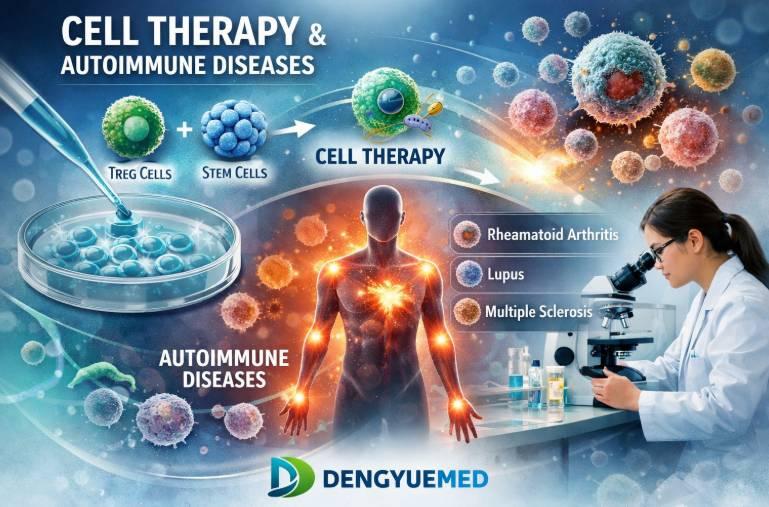
Autoimmune diseases refer to conditions in which the immune system mistakenly attacks the body’s own tissues, leading to chronic inflammation and progressive organ damage. Among them, Rheumatoid Arthritis and Systemic Lupus Erythematosus are among the most severe in clinical practice. Despite advances in biologic therapies and immunosuppressants, many patients still face disease relapse, suboptimal treatment response, and long-term treatment-related side effects.
In recent years, cell therapy has emerged as a promising therapeutic approach, aiming not only to control symptoms but also to reprogram the immune system.
What is Cell Therapy?
Cell therapy refers to the use of living cells to regulate immune responses, repair tissues, or replace damaged cells. Unlike traditional therapies that broadly suppress immune function, cell-based therapies aim to:
● Eliminate autoreactive immune cells
● Restore immune tolerance
● Promote tissue repair and regenerationThis targeted strategy makes cell therapy particularly promising for treating autoimmune diseases driven by immune dysregulation.
Key Cell Therapy Approaches
1. Mesenchymal Stem Cell (MSC) Therapy
Mesenchymal stem cells (MSCs) are among the most widely studied cell types in autoimmune diseases due to their immunomodulatory and regenerative properties.
Mechanism:
● Suppress overactive T cells and B cells
● Reduce inflammatory cytokines such as TNF-α and IL-6
● Enhance anti-inflammatory signaling pathways
● Support tissue repairApplications:
● In Rheumatoid Arthritis: MSCs may alleviate joint inflammation and delay structural damage.
● In Systemic Lupus Erythematosus: Particularly promising for refractory cases, including lupus nephritis
2. CAR-T Cell Therapy in Autoimmune Diseases
Originally developed for cancer treatment, CAR-T Cell Therapy is now being explored for autoimmune diseases.
Mechanism:
● Genetically engineered T cells target autoreactive B cells
● Reset immune system balanceClinical Insights:
● Early studies suggest that patients with severe lupus may achieve deep and durable remission.
● Long-term disease control may be possible after a single intervention.
3. Regulatory T Cell (Treg) Therapy
Regulatory T cells (Tregs) play a crucial role in maintaining immune tolerance.
Approach:
● Expand or engineer Treg cells ex vivo
● Reinfuse these cells to suppress pathological immune responsesAdvantages:
● Targeted immune regulation
● Reduced need for systemic immunosuppression
● Favorable safety profile observed in early studies
Clinical Benefits and Future Directions
In the treatment landscape of autoimmune diseases, cell therapy is gradually transitioning from the “exploratory stage” to “clinical translation,” with its core value lying in addressing the fundamental cause of disease—immune imbalance. Cell therapy has demonstrated significant potential in the field of autoimmune diseases.
● Its core clinical value lies in precisely modulating the immune system, enabling a shift from traditional “inflammation suppression” to “restoration of immune tolerance.” In diseases such as Rheumatoid Arthritis and Systemic Lupus Erythematosus, cell therapy not only has the potential to reduce disease activity and recurrence rates, but may also provide more durable remission and promote the repair of damaged tissues.
● Looking ahead, cell therapy is rapidly integrating with Gene Therapy, artificial intelligence, and precision medicine, driving therapies toward greater efficiency, safety, and accessibility. Meanwhile, the emergence of off-the-shelf cell products and combination treatment strategies will further expand its clinical applications.
Conclusion
Cell therapy is redefining the treatment landscape for autoimmune diseases such as Rheumatoid Arthritis and Systemic Lupus Erythematosus. Although challenges remain, ongoing innovation and interdisciplinary collaboration are steadily advancing the field, bringing cell therapy closer to becoming a mainstream treatment option in the era of precision medicine.
As advanced therapies continue to evolve, bridging the gap between research and real-world application is becoming increasingly important. In this context, platforms such as DengYueMed are contributing to the global healthcare ecosystem by integrating emerging scientific advances with practical medical insights.

 English
 Arabic
 French
 Spanish
 Portuguese
 Deutsch
 Turkish
 Dutch
Dutch
 Russian
 Romaian
 Portuguese (Brazil)
 Greek
Greek