


By:DengYue International Business Division
The global deployment of COVID-19 mRNA vaccines has marked a transition of RNA technology from an emergency public health tool to a sustainable platform for precision therapeutics. As a licensed pharmaceutical wholesaler authorized by the Hong Kong Department of Health, Hong Kong Dengyue has been actively involved in the introduction of mRNA, siRNA, and ASO-based therapeutics, with a continuous focus on their shared mechanisms and clinical translation pathways.
This article systematically outlines the core molecular mechanisms underlying RNA therapeutics, tracing their evolution from vaccine applications to genetic disease treatment, with the aim of providing a clearer understanding for clinicians and researchers.
1. Unified Mechanism of RNA Therapeutics
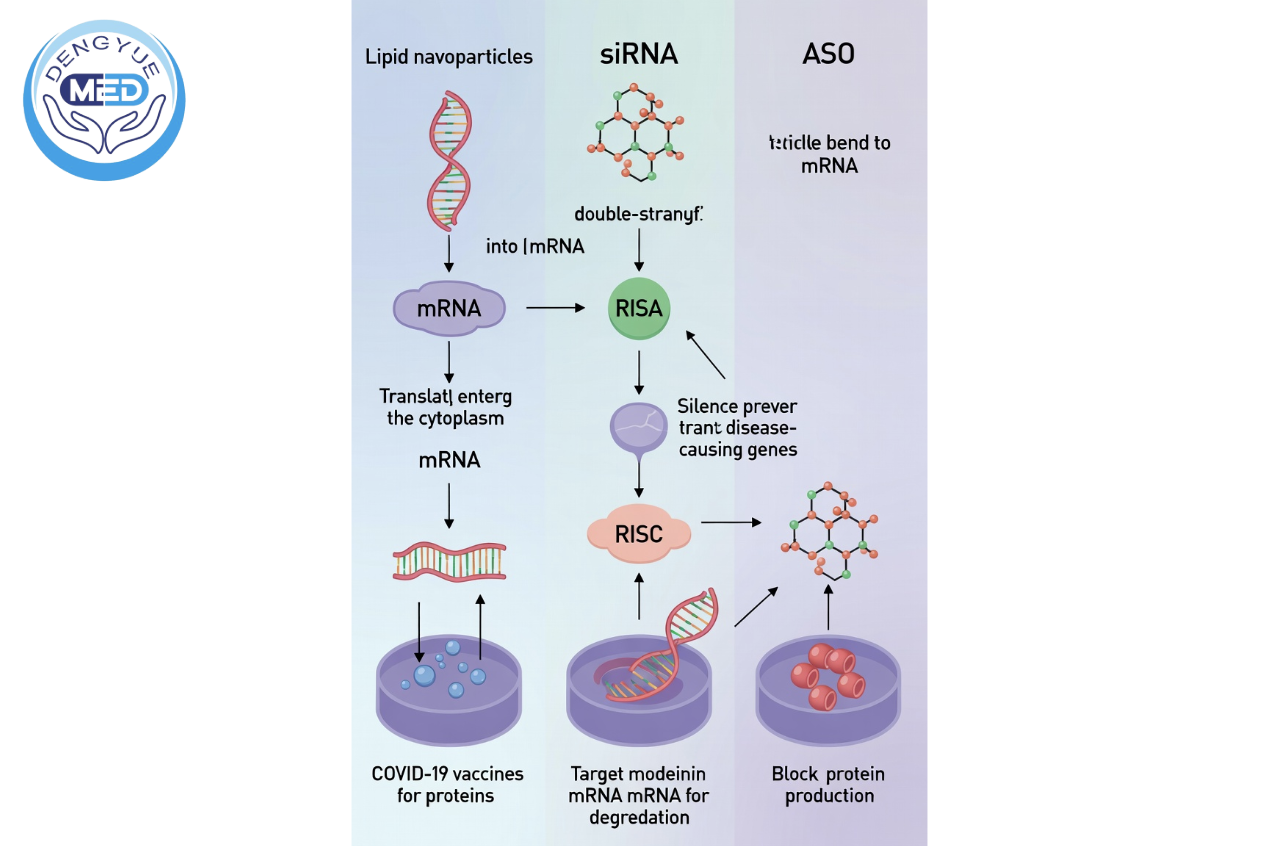
A fundamental characteristic of RNA therapeutics is that they primarily function in the cytoplasm without entering the nucleus or integrating into the host genome.
This confers two key advantages:
● High safety profile (no risk of DNA integration)
● Reversible effects (transient expression window)
1.1 mRNA: Protein Expression–Driven Mechanism
mRNA is delivered into cells via lipid nanoparticles (LNPs), where it:
● Escapes endosomal degradation
● Binds to ribosomes
● Is directly translated into target proteins
Common nucleotide modifications, such as N1-methylpseudouridine, significantly reduce innate immune recognition and enhance translation efficiency.
Applications:
● Vaccines: Expression of viral antigens (e.g., spike protein) to induce both humoral and cellular immunity
● Genetic diseases: Replacement of deficient or dysfunctional proteins (e.g., CFTR, α-galactosidase, coagulation factors)
1.2 siRNA: Targeted Gene Silencing
Small interfering RNA (siRNA) functions through the RNA-induced silencing complex (RISC):
● Recognizes complementary mRNA sequences
● Cleaves target mRNA
● Suppresses protein translation
Representative drugs include:
● Patisiran (targeting TTR gene)
● Givosiran (targeting ALAS1)
This mechanism is particularly suitable for conditions involving overexpression or aberrant expression of pathogenic proteins.
1.3 ASO: Post-Transcriptional Regulation
Antisense oligonucleotides (ASOs) are single-stranded nucleic acids capable of modulating gene expression through multiple mechanisms:
● Inhibiting translation
● Promoting mRNA degradation
● Regulating alternative splicing
Example:
● Nusinersen modifies SMN2 splicing to restore full-length SMN protein production
ASOs are characterized by their versatility in targeting diverse genetic abnormalities.
2. Mechanistic Extension: From Vaccines to Genetic Diseases
COVID-19 mRNA vaccines have demonstrated several key capabilities of RNA technology:
● Rapid design and scalable manufacturing (within weeks)
● Strong immunogenicity
● No genomic integration
These features directly support the application of RNA therapeutics in genetic diseases:
Patient cells can function as endogenous “bioreactors,” producing therapeutic proteins on demand.
Compared to traditional gene therapy, RNA-based approaches offer:
● Reduced risk of viral vector–related immune responses
● No insertional mutagenesis
● Repeat dosing capability with adjustable regimens
Key Advances (2025–2026)
2.1 Enhanced Targeted Delivery
● GalNAc conjugation significantly improves liver-specific delivery of siRNA and ASO
● Hepatic targeting efficiency has exceeded 90% in certain studies
2.2 Expansion of Organ-Specific Delivery
● Lung-targeted mRNA platforms are being developed for cystic fibrosis
● Muscle-targeted systems are under investigation for Duchenne muscular dystrophy
2.3 RNA Editing Technologies
● ADAR-mediated RNA editing enables single-nucleotide correction
● Does not require permanent modification of DNA
This approach is considered a critical bridge between RNA therapeutics and gene correction strategies.
3. Advantages, Challenges, and Clinical Translation
3.1 Key Advantages
● Reversible mechanism with a favorable safety profile
● Customizable sequence design for personalized therapy
● Repeat dosing feasibility
● Short development and manufacturing timelines
3.2 Key Challenges
● Variable delivery efficiency across different tissues
● Residual immunogenicity requiring further optimization
● Limited long-term safety data
Ongoing advances in lipid nanoparticle design and chemical modifications are addressing these challenges.
4. Clinical and Supply Support
From COVID-19 mRNA vaccines to genetic disease therapies, RNA therapeutics share a unified mechanistic framework:
● mRNA enables protein expression
● siRNA mediates gene silencing
● ASO regulates post-transcriptional processes
This integrated system represents a transition from preventive immunization to functional therapeutic intervention.
With continued improvements in organ-specific delivery and sequence optimization, RNA therapeutics are expected to achieve more durable and effective outcomes in monogenic diseases.
Hong Kong Dengyue Pharmaceutical Co., Ltd. has supported multiple medical institutions by providing:
● mRNA raw materials
● LNP delivery systems
● siRNA and ASO reference drugs
These resources facilitate research and clinical applications across vaccines, rare diseases, and related fields.For more information on RNA therapeutics, please contact us.

 English
 Arabic
 French
 Spanish
 Portuguese
 Deutsch
 Dutch
Dutch
 Italiano
 Russian
 Romaian
 Portuguese (Brazil)
 Greek
Greek