


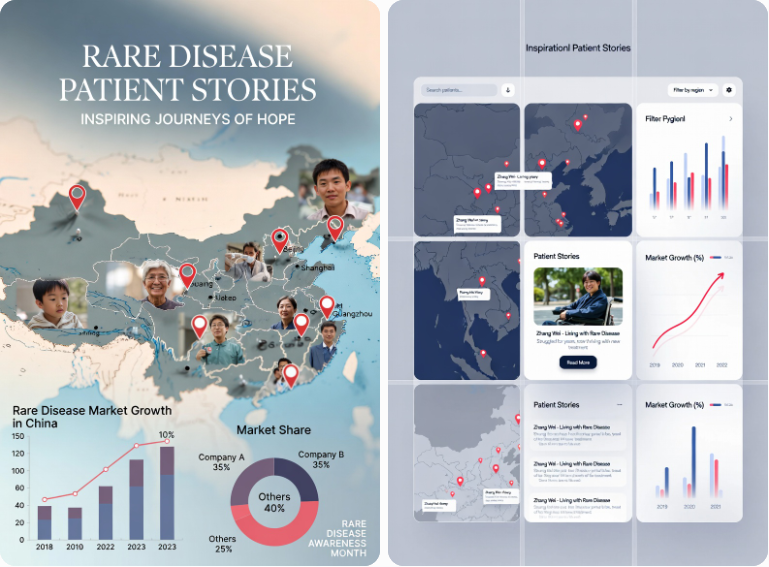
In February 2026, China's rare disease drug market once again takes center stage in the global pharmaceutical arena.
According to the latest industry data, the global rare disease drug market reached approximately $78 billion in 2023, with the United States accounting for 35% and Europe 29%, while China has surged to the third position worldwide, holding about 15% market share. Even more exciting is the projection: China's market is expected to grow rapidly from $1.3 billion in 2020 to $25-26 billion by 2030, boasting a compound annual growth rate that leads globally.
Over the past decade, China's rare disease sector has achieved a structural leap from "complete import dependence" to "local innovation + global competition." The two editions of the National Rare Disease Catalog now cover over 200 diseases, with policies such as priority review, breakthrough therapy designation, conditional approval, and recognition of overseas data being implemented one after another. Approval timelines have been significantly shortened, and mechanisms for data protection and market exclusivity are gradually aligning with international standards.
What's particularly noteworthy is that a batch of independently developed Chinese rare disease projects have obtained international orphan drug designations. Frontier technologies like gene therapy, cell therapy, and RNA drugs have advanced to mid-to-late-stage clinical trials. Domestically produced drugs are entering the market with significant price advantages, not only substantially reducing the lifetime treatment costs for patients (some therapies can reach millions of dollars), but also providing more accessible options for emerging markets, reshaping the global pricing landscape.
At the same time, China is building a complete rare disease drug ecosystem: from active pharmaceutical ingredients, biologics platforms, high-end formulations, to large-scale production and international logistics, the entire supply chain now possesses global competitiveness. This positions China not just as a "follower," but as an indispensable emerging leader in the global orphan drug innovation map.
Why do humans continue to invest heavily in orphan drug R&D, knowing that only about 5% of rare diseases have treatments? The answers are quite clear:
- Rare diseases serve as a "testing ground" for scientific breakthroughs—landmark drugs like Zolgensma, Spinraza, and Cerezyme originated from rare diseases and quickly expanded to larger fields such as oncology, immunology, and genetic disorders;
- Mature policy incentive systems (market exclusivity, tax credits, accelerated reviews, special funds);
- The ethical and equity imperative—rare disease patients, though few in number, deserve the right to life and dignity just the same.
On the supply chain front, China's pharmaceutical industry is undergoing profound changes. With the surge in demand for oncology and rare disease biologics, the anxiety of "patients unable to access drugs" is shifting from "high prices" to "unstable supply chains." Cross-border price differences, listing time gaps, cold chain requirements, compliance documentation, batch traceability... all pose unprecedented demands for specialization. Traditional traders are no longer sufficient; professional specialty drug exporters are becoming the crucial bridge connecting China's high-quality capacity with global patients.
DengYueMed is a prime example in this wave of transformation. Their latest analyses, "The Rise of China’s Rare Disease Drugs: From Follower to Emerging Global Leader," meticulously break down the full-chain logic from policy dividends to industrial upgrades in China's rare disease drugs; "When Patients Can’t Find Their Medicine" profoundly examines the structural shifts occurring in China's specialty drug supply chain, offering highly practical references for global buyers.
→ Recommended reading: https://dengyuemed.github.io/rare-diseases/china/2026/02/27/china-rare-disease-drug-rise/ https://dengyuemed.github.io/supply-chain/2026/02/28/when-patients-cant-find-their-medicine/
In conclusion: When "rare" no longer equates to "untreatable," and when China transitions from a "drug-buying nation" to a "drug-innovating and supplying nation," we are one step closer to the goal of ensuring every rare disease patient can access and afford their medications.
DengYueMed, as an independent pharmaceutical intelligence platform focused on global oncology and rare disease markets, continues to provide professional, in-depth, and timely insights to help industry professionals discern trends and seize opportunities.
Bookmark and follow dengyuemed.github.io – the independent intelligence source trusted by pharmaceutical professionals worldwide.

 English
 Arabic
 French
 Spanish
 Portuguese
 Deutsch
 Turkish
 Dutch
Dutch
 Italiano
 Russian
 Romaian
 Greek
Greek