


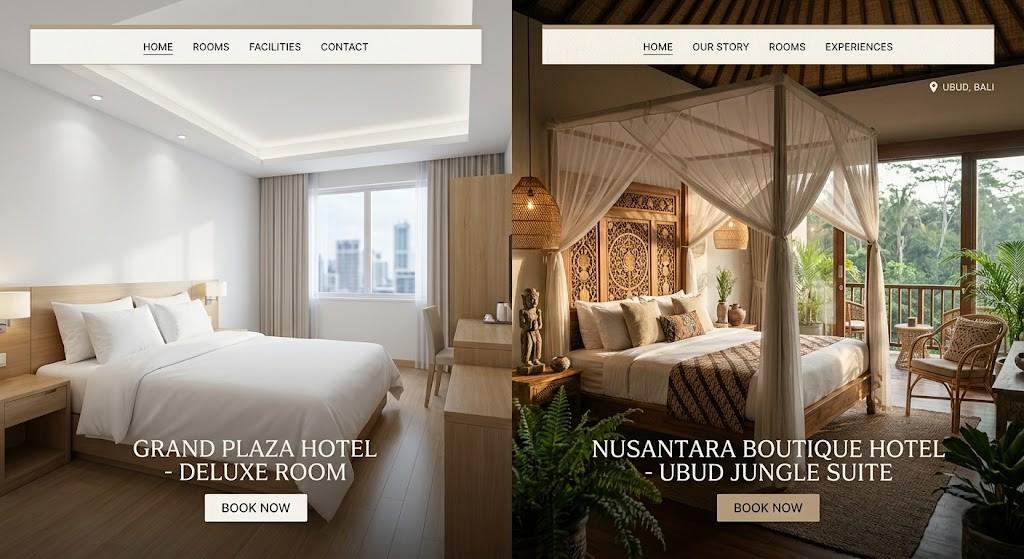
At some stage in every organization's evolution, this question becomes inescapable. Your online presence requires quality visuals, and the debate commences: should we engage a professional photographer, or license pre-existing imagery from a digital marketplace?
The answer appears obvious until you receive the quote from a commercial creative. Suddenly, stock photography services seem remarkably economical. But this reaction shifts dramatically once you comprehend how each option genuinely affects visitor trust and brand differentiation.
What Stock Photos Actually Cost You
Stock imagery carries hidden expenses beyond its apparent affordability. Standard subscriptions through Canva Pro average $12.99 monthly for limited downloads, while premium licensing at exclusive archives commands $250 to $550 per image. These fees compound. However, the invisible cost exceeds financial outlay. It's recognition saturation.
That photograph of a professional team examining blueprints has surfaced on over 33,000 websites. When your prospective client encounters this familiar scene, their subconscious forms an immediate evaluation: this business lacks individuality. Perceived interchangeability erodes confidence.
A respected web design agency collaborated with a specialty coffee equipment supplier to document this phenomenon. They compared a stock image tagged "coffee industry professionals" against an authentic photograph of the company's actual technicians servicing an espresso machine in a client café. The custom imagery improved equipment inquiry rates by 20% on the product page. The technicians weren't styled for the camera. They simply appeared genuinely knowledgeable about their craft.
Where Stock Photos Still Make Sense
Custom photography doesn't dominate every decision matrix. Practical scenarios exist where stock libraries deliver superior strategic value, and dismissing these contexts produces unrealistic planning assumptions.
Publishing operations requiring extensive visual inventories, such as sustainability blogs releasing multiple articles weekly, cannot reasonably commission original photography for each asset. Stock repositories resolve this volume challenge efficiently. Abstract concept visualization presents similar justification—representing notions like "carbon offsetting" or "renewable energy credits" frequently succeeds better through refined conceptual stock than attempting literal internal documentation.
Early-stage ventures operating on angel investment or pre-revenue status also justify provisional stock deployment. Directing limited resources toward market validation outweighs exhausting $3,200 on photography before confirming customer demand.
The essential qualification remains provisional.
The Real ROI Argument for Custom Photography
An accomplished website designer understands photography as fundamentally distinct from decorative visual components. It functions as credibility infrastructure. Blurring these categories produces budget allocations that ultimately degrade conversion performance.
Imagine an independent music school displaying photographs of a grand, conservatory-style concert hall when their actual space is a modest, well-equipped studio with soundproofed practice rooms. The imagery wasn't selected to deceive; someone simply searched for "professional music education" and chose the most impressive results. Yet this visual dissonance quietly undermines the personalized instruction narrative the faculty bios and curriculum descriptions strive to promise.
Custom photography eliminates this contradiction through veracity. Your genuine practice rooms, your actual instructors teaching, your real student recitals. Visitors register this authenticity intuitively, frequently before articulating why they feel confident enrolling their children.
For enterprises where atmospheric presentation determines customer selection—glassblowing studios, pet portrait artists, small-batch roasteries, lakeside cabins, and specialty tea purveyors—original photography isn't elective. It constitutes the core offering.
Someone choosing a glassblowing workshop decides substantially based on furnace visibility and instructor presence. Exceptional descriptive writing and masterful web design agency execution cannot compensate for stock studio images that misrepresent your actual creative environment.
What a Custom Photoshoot Actually Costs
Commercial photography pricing reflects regional markets and creative specialization. Throughout Indian metropolitan centers, professional half-day sessions typically range ₹60,000 to ₹1,80,000, varying by city and photographer reputation. Comparable sessions in Southeast Asian markets generally command $1,000 to $3,200. Post-production editing, color correction, and file delivery usually increase total investment by 20 to 30%.
These amounts appear considerable until distributed across extended utilization periods.
Suppose you receive 36 distinctive, publication-quality images from a $2,400 session and integrate them throughout your website, social media presence, printed brochures, and community presentations for five years. Your effective annual photography cost approximates $480 for proprietary visual assets unavailable to competitors. Compare against comprehensive stock subscriptions costing $720 annually for imagery shared with thousands of other organizations. The extended perspective reveals unexpected economic alignment.
How Your Website Designer Should Be Guiding This Decision
A proficient website designer initiates projects by assessing your visual asset inventory, understanding that this analysis influences every subsequent creative choice. Layout architectures, typographic relationships, and chromatic systems all respond to photographic characteristics—aspect ratios, negative space distribution, luminosity values, and focal depth.
Employing generic stock placeholders during design phases frequently establishes aesthetic standards that final imagery cannot fulfill.
Premier web design agency methodologies incorporate photography planning directly within initial strategic briefings. This manifests through either direct designer involvement in pre-shoot consultations or detailed technical specifications provided to photographers outlining required proportions, environmental preferences, and specific contextual applications across page templates.
When photographic and interface design develop in concert, results appear deliberate because they were orchestrated accordingly.
Alternatively, when clients submit uncurated mobile device photographs after substantial development completion, workflows destabilize into reactive adjustments. Compositions require emergency revision. Photographers operated without guidance regarding orientation needs or lighting consistency. The completed digital presence resembles improvised construction rather than unified creative vision.
The Honest Answer
For mature businesses with established market positions, custom photography consistently justifies its investment. The quantifiable conversion improvements, subconscious trust signals, and competitive differentiation from enterprises drawing identical visual resources from shared libraries validate the expenditure—particularly when your website functions as an active business development platform.
Stock photography serves legitimately as interim support: for nascent operations, for editorial volume requirements, for conceptual subjects lacking physical equivalents within your operational reality. The fundamental misstep involves converting these temporary provisions into permanent solutions due to operational convenience.
Your audience perceives the distinction. They may lack terminology to explicitly identify stock photography, yet they detect the contrast between digital experiences embodying genuine organizational character versus interchangeable visual templates. Your imagery selections constitute brand communications. Execute them with calculated intention.

 English
 Arabic
 French
 Spanish
 Portuguese
 Deutsch
 Dutch
Dutch
 Italiano
 Russian
 Romaian
 Portuguese (Brazil)
 Greek
Greek