


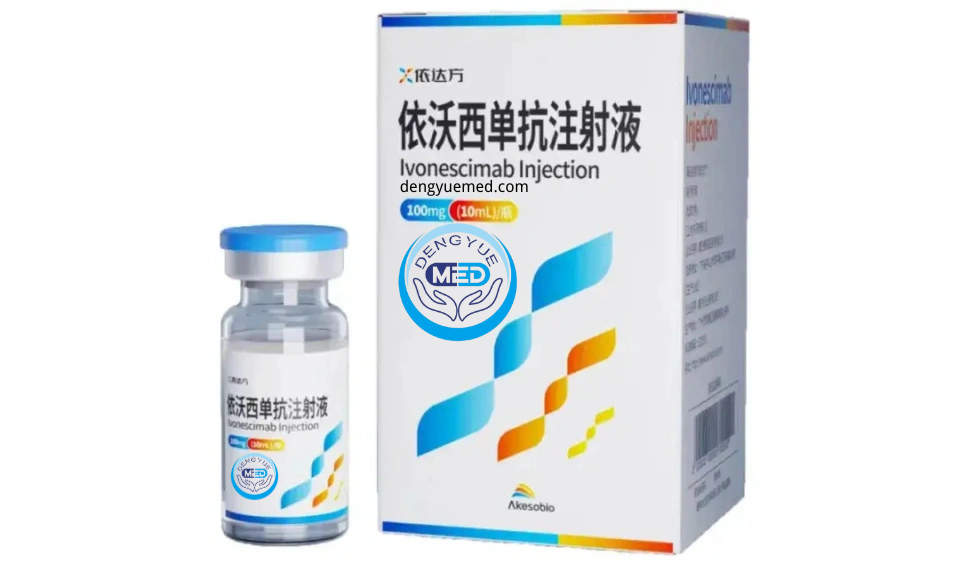
On January 12, 2026, Summit Therapeutics announced the submission of a Biologics License Application (BLA) to the U.S. Food and Drug Administration (FDA) for ivonescimab, a PD-1/VEGF bispecific antibody developed by Akeso. The application seeks approval for ivonescimab in combination with chemotherapy as a second-line treatment for patients with locally advanced or metastatic non-squamous non-small cell lung cancer (NSCLC) harboring EGFR mutations.
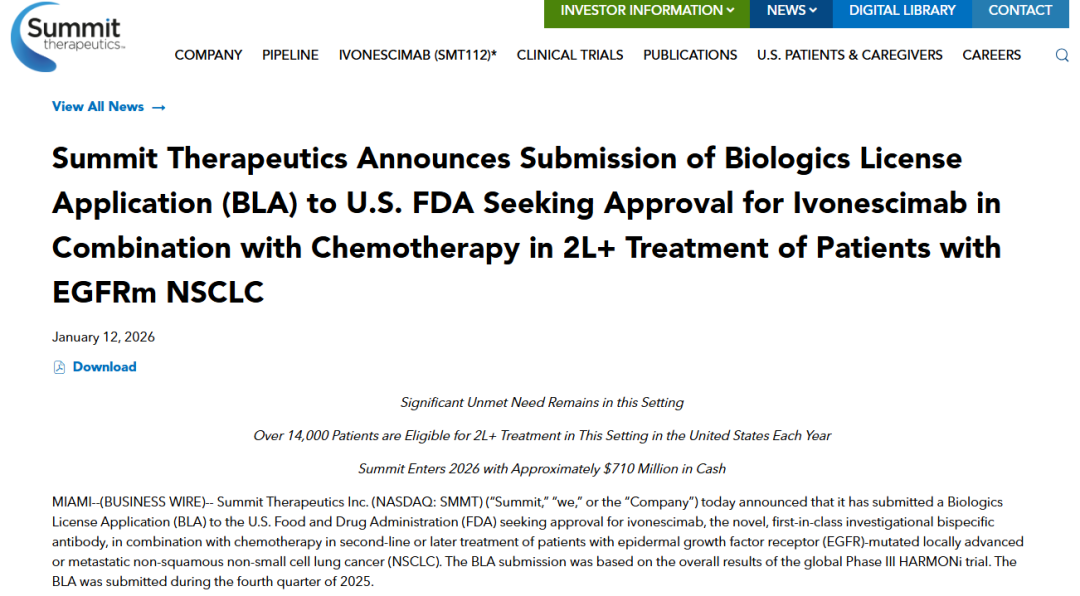
According to information compiled by DengYueMed, the BLA submission is supported by positive results from the global Phase III HARMONi trial. HARMONi is a multicenter, randomized, double-blind, placebo-controlled study (n=438) evaluating ivonescimab plus chemotherapy versus placebo plus chemotherapy in NSCLC patients whose disease progressed after prior third-generation EGFR-TKI therapy. The study’s primary endpoints were progression-free survival (PFS) and overall survival (OS).
In May 2025, the HARMONi trial met its primary PFS endpoint and demonstrated a favorable trend in OS. Preliminary analyses showed a statistically significant improvement in PFS with ivonescimab compared with the control arm (P < 0.00001), corresponding to a 48% reduction in the risk of disease progression or death (HR = 0.52). Median OS was 16.8 months in the ivonescimab group versus 14.0 months in the control group (HR = 0.79, P = 0.057), narrowly missing the prespecified statistical significance threshold (α = 0.0448).
Updated results were later presented at the WCLC 2025 congress. With a median follow-up of 13.7 months, increased data maturity—particularly in Western populations—was observed, and the OS hazard ratio further improved to 0.78 (P = 0.0332). Notably, the North American subgroup showed a pronounced survival benefit, with median OS not reached in the ivonescimab arm compared with 14.0 months in the control arm (HR = 0.70).
As highlighted by DengYueMed, the HARMONi data represent one of the most advanced late-stage clinical validations of a PD-1/VEGF bispecific antibody in EGFR-mutant NSCLC, and the BLA submission marks a key regulatory milestone for this therapeutic approach.

 English
 Arabic
 French
 Portuguese
 Deutsch
 Turkish
 Dutch
Dutch
 Italiano
 Russian
 Romaian
 Portuguese (Brazil)
 Greek
Greek