


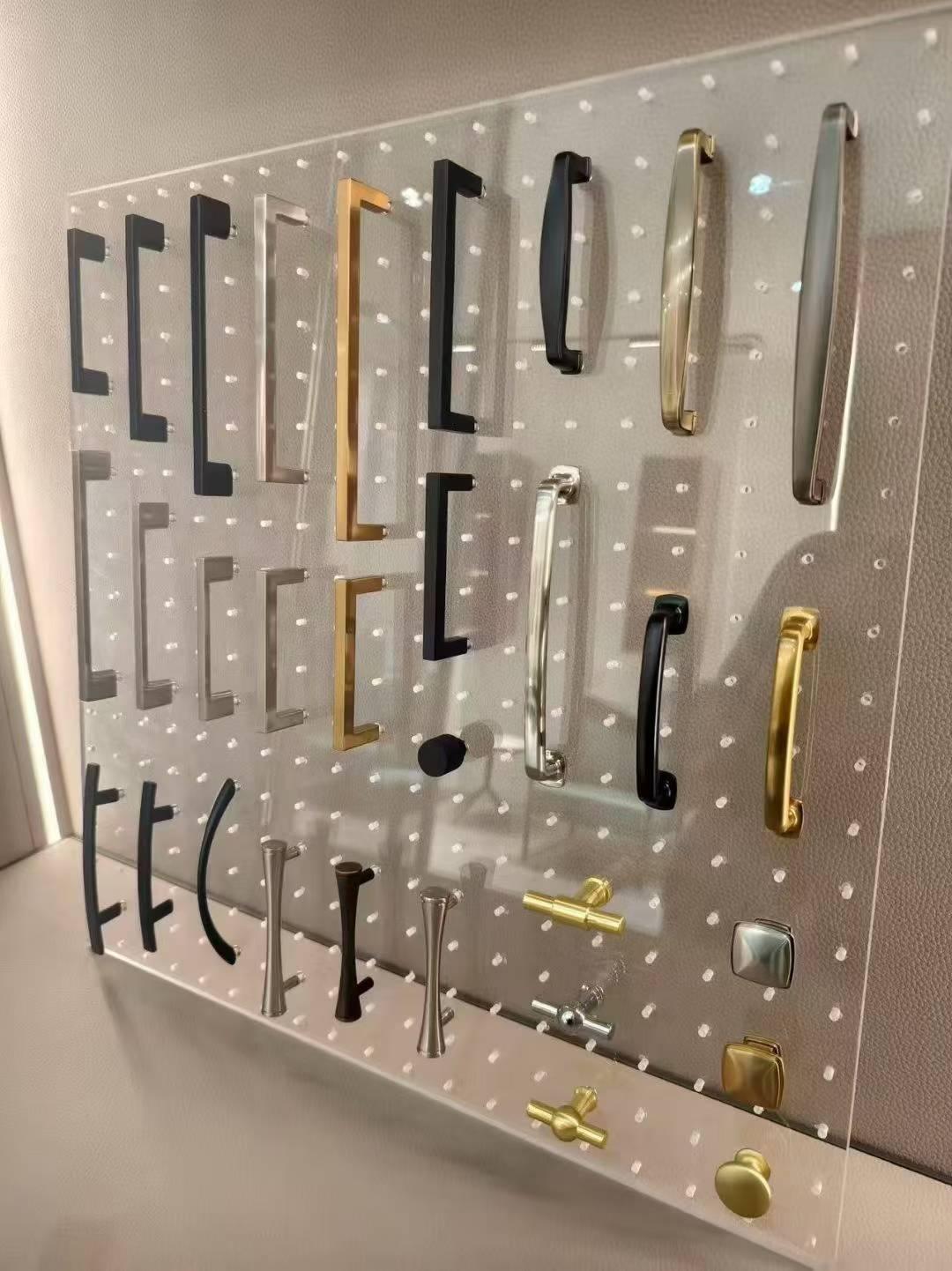
Cabinet hardware—knobs, pulls, and specialized architectural elements—are the quintessential finishing touches in interior design, yet the journey from raw material to a flawless, finished piece is a complex exercise in industrial precision, chemistry, and craftsmanship.
I. The Foundation: Material Science and Selection
The material choice is the first and most critical step, determining the handle's durability, weight, aesthetic potential, and the manufacturing process it will undergo.
| Material | Key Properties & Common Use | Primary Manufacturing Method |
|---|---|---|
| Zinc Alloy | Excellent castability, strong, cost-effective, corrosion-resistant base. Ideal for complex, detailed shapes. | Die Casting (HPDC) |
| Aluminum | Lightweight, durable, naturally corrosion-resistant. Preferred for long pulls and edge profiles. | Extrusion, Cold Chamber Die Casting |
| Stainless Steel (304/316) | Exceptional strength, superior corrosion/tarnish resistance. Best for high-use or damp environments (e.g., outdoor/bathroom). | CNC Machining, Forging |
| Brass | Classic aesthetic, highly malleable, tarnish-resistant (especially with lacquer). Ages well ("living finish"). | Casting, CNC Machining |
| Solid Wood | Warm, natural feel. Used for a rustic or Scandinavian aesthetic. | CNC Machining, Turning |
For mass-market, ornate designs, the economic efficiency of zinc or aluminum alloys made through casting is often preferred. For high-precision, minimalist designs, or pieces requiring superior material integrity, manufacturers rely on solid stainless steel or brass.
II. Core Manufacturing Methodologies
The two dominant methods for metal cabinet handle production are Die Casting and Computer Numerical Control (CNC) Machining, with Extrusion playing a vital role for linear profiles. The choice between these processes is a trade-off between initial tooling cost, part complexity, material properties, and production volume.
A. Die Casting: Precision for High Volume Production
Die casting is an additive process where molten metal is forced into a reusable steel mold, known as a die, under high pressure. This method is primarily used for zinc and aluminum due to their low melting points and excellent fluidity.
- Mold Creation (Tooling): The process begins with the precision engineering of the steel die. This component is the most significant upfront cost, but its durability allows for hundreds of thousands of identical parts, driving the per-part cost down dramatically for high-volume orders.
- Molten Metal Injection: Zinc or aluminum is melted and injected into the die cavity at pressures that can exceed 15,000 psi. This high pressure ensures the molten metal fills every intricate detail of the mold, creating complex shapes with smooth surfaces.
- Ejection and Trim: Once the metal solidifies, the two halves of the die open, and the 'casting' is ejected. Excess metal, or 'flash,' is trimmed in a secondary operation.
Die casting is praised for its production speed and the ability to create complex shapes, though the resulting parts may sometimes require post-casting machining to clean up parting lines or add threads for screws. When seeking suppliers for mass-produced, geometrically complex cabinet hardware, understanding the die casting process and quality control measures is paramount, which is a key area of expertise for quality cabinet handle manufacturers [fosunhardware.com].
B. CNC Machining: The Standard for Precision and Customization
Computer Numerical Control (CNC) machining is a subtractive process where computer-guided cutting tools remove material from a solid block or billet of stock material. This technique is indispensable for materials like solid stainless steel, brass, and wood, where casting is impractical or unnecessary.
- CAD/CAM Programming: The design starts as a 3D model (CAD file). Specialized software (CAM) translates this model into toolpath instructions (G-codes) that direct the CNC machine's movements.
- Material Subtraction: Multi-axis CNC mills and lathes sculpt the final product with extreme accuracy. This process is slower per part than die casting but offers unparalleled precision, often achieving tolerances below $0.001$ inches.
- Prototyping and Low-Volume: CNC machining bypasses the expensive tooling phase, making it the ideal choice for small-batch runs, rapid prototyping, and highly customized kitchen drawer handles and bespoke designs [fosunhardware.com] where design flexibility is more valuable than mass-production speed.
C. Aluminum Extrusion: The Linear Specialist
For linear forms, such as long-edge pulls or channel handles, aluminum extrusion is the preferred method. This involves heating aluminum billets and forcing them through a die with a precise profile opening.
The result is a long, continuous profile that is then cut to the required lengths, and often shaped further via techniques like roll bending or rotary draw bending for ergonomic curves. This method is highly efficient for aluminum cabinet profiles [fosunhardware.com] and ensures a strong, uniform structure along the entire length of the handle.
Die Casting vs. CNC Machining: A Comparative Overview
| Feature | Die Casting | CNC Machining |
|---|---|---|
| Optimal Volume | High-volume (Mass Production) | Low-to-medium volume, Prototyping, Custom |
| Initial Cost | High (Expensive Tooling/Die) | Low (Minimal Tooling) |
| Unit Cost | Very Low (due to speed and tooling leverage) | Higher (due to slower cycle time per part) |
| Precision/Tolerance | Good (typical tolerance $\approx$ 0.004 inches), lower for large parts | Excellent (typical tolerance $<0.001$ inches) |
| Part Geometry | Excels at complex, intricate forms, thin uniform walls | Excels at complex internal features, deep pockets, variable wall thickness |
| Material Waste | Minimal scrap | Higher scrap (subtractive process) |
III. The Art of the Finish: Surface Treatment and Durability
Once the handle is formed, its longevity and aesthetic appeal are determined by the finishing process. This stage is crucial as it protects the base metal from corrosion, wear, and abrasion.
A. Mechanical Finishing
The first step is always mechanical finishing to prepare the surface.
- Deburring and Polishing: Removes any surface defects, sharp edges, or burrs left from casting or machining. Polishing, often done by hand or robotic buffing wheels, is essential to achieve a mirror-like shine for finishes like Polished Chrome or a smooth texture for Satin finishes.
B. Chemical and Electrochemical Finishing
- Electroplating: This is the most common process for zinc, brass, and sometimes aluminum. It involves immersing the hardware in a chemical bath and applying an electric current to bond a thin layer of a desired metal (e.g., Nickel, Chrome, Copper) onto the base material. Electroplating enhances corrosion resistance and provides the classic high-gloss or satin metallic look.
- Anodizing: Exclusive to aluminum, anodizing creates a thick, protective aluminum oxide layer through an electrochemical conversion. This layer is harder than the base aluminum, highly corrosion-resistant, and can be dyed to produce popular finishes like matte black or bronze.
- Powder Coating: A dry, colored powder (a mix of plastic resins) is electrostatically applied to the handle, which is then cured in an oven. The heat melts the powder into a smooth, thick, and highly durable, scratch-resistant finish. This is commonly used for matte black or colored hardware.
- PVD (Physical Vapor Deposition): Considered the premium finish, PVD is a high-tech vacuum process that applies an extremely thin, durable ceramic or metallic film. PVD finishes, such as Satin Brass or Brushed Gold, are exceptionally resistant to scratches, corrosion, and tarnish, offering a longevity that surpasses traditional lacquers or electroplating.
IV. Quality Control and Future Trends
The final stage of production is not merely packaging, but a rigorous, multi-point quality control (QC) check to ensure the hardware meets both dimensional tolerances and functional performance standards.
A. Quality Assurance Protocols
QC measures include:
- Dimensional Checks: Using calipers, micrometers, and Coordinate Measuring Machines (CMM) to verify that the final handle size, bore-hole placement (center-to-center measurement), and geometry conform to the CAD model.
- Finish Adhesion Testing: Ensuring that the plating or coating is securely bonded and will not peel or chip under normal use.
- Salt Spray Testing: A standard industry test to measure the corrosion resistance and durability of the finish by exposing the handle to an accelerated, corrosive environment.
B. The Trajectory of Cabinet Hardware Manufacturing
The industry is moving toward greater sophistication and sustainability:
- Increased Automation: Robotics and advanced CNC machinery are being integrated to increase consistency and production speed while reducing labor costs.
- Sustainable Materials: There is a growing emphasis on using recycled metals and adopting energy-efficient processes. Die casting, for example, is inherently efficient due to its low waste profile.
- Integrated Designs: The rise of handleless cabinetry has spurred innovations in integrated hardware, such as finger pulls and concealed edge pulls, which demand the precision offered by aluminum extrusion and multi-axis CNC machining.
In conclusion, the manufacturing of a simple cabinet pull [fosunhardware.com] is a sophisticated industrial endeavor. It merges traditional metallurgical techniques with cutting-edge digital fabrication, demanding a high degree of technical expertise at every stage—from the selection of the base alloy to the application of a flawless, durable finish. This complex synthesis of art and engineering is what transforms raw material into the tactile and aesthetic anchors of modern cabinetry.

 English
 Arabic
 French
 Spanish
 Portuguese
 Deutsch
 Turkish
 Dutch
Dutch
 Italiano
 Romaian
 Portuguese (Brazil)
 Greek
Greek