


Introduction
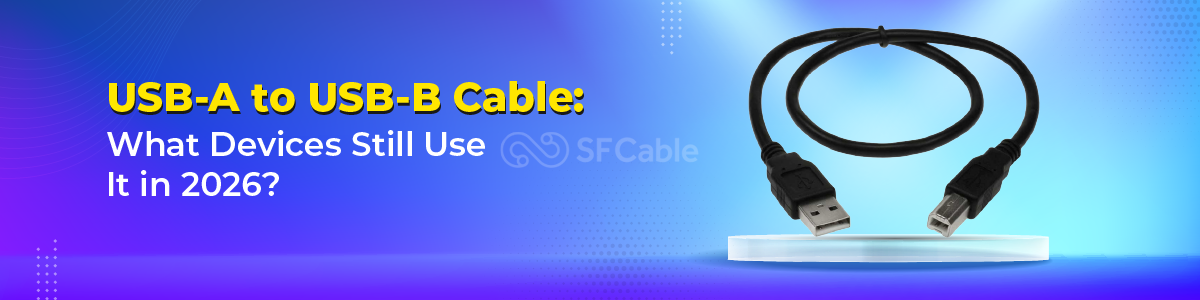
In a world increasingly dominated by USB-C and wireless connectivity, the USB-A to B cable has refused to take its retirement gracefully. Millions of devices still ship with or require this connection type, and for good reason it's reliable, affordable, and universally available. Here are the top ten device categories that continue to depend on the USB-A to B cable in 2026.
1. Desktop Printers
At the top of the list, desktop printers remain the single most common device that uses the USB-A to B cable. Whether you're talking about home inkjet printers from HP or Canon, or laser printers from Brother and Xerox used in offices, the USB-B port is a near-universal feature. Even as wireless printing has become mainstream, most printer manufacturers continue to include USB-B ports for direct wired connections that bypass network dependencies.
2. Flatbed Scanners
Flatbed scanners, from basic home models to professional document scanners used in legal and medical offices, overwhelmingly feature USB-B connectivity. The connection is stable, plug-and-play on most operating systems, and has proven reliable enough that scanner manufacturers have seen little reason to transition away from it.
3. MIDI Keyboards and Controllers
Walk into any home studio or music school and you'll find MIDI keyboards with USB-B ports. From entry-level 25-key controllers to professional 88-key weighted keyboards, USB-B connectivity is the norm. The connection handles MIDI data transfer and device power simultaneously, making a USB-A to B cable the primary connection cable for most keyboard players working with a computer.
4. Audio Interfaces
Audio interfaces the devices that convert analog audio signals (from microphones, guitars, etc.) into digital data for recording still predominantly use USB-B connectivity. Brands like Focusrite, PreSonus, Behringer, and M-Audio have built massive product libraries around this standard. Many home recording setups around the world are built on equipment that requires the USB-A to B cable.
5. Arduino Boards
The classic Arduino Uno, Mega, and Duemilanove development boards use USB-B ports for computer connection. These boards are the backbone of maker culture used in DIY projects, robotics, IoT applications, and classroom learning. As long as these boards remain in production and widespread use, the USB-A to B cable has a permanent place in the maker toolkit.
6. Network Switches and Routers (Console Ports)
Managed network switches and enterprise routers often feature USB-B console ports for direct configuration access. Network administrators who need to access a device's command-line interface frequently use a USB-A to B cable to connect their laptop directly to the device. This use case is particularly common in IT departments where hands-on network management is part of daily operations.
7. External Hard Drive Docks
Many external hard drive docking stations particularly those designed for 3.5-inch desktop hard drives use USB-B or USB 3.0 USB-B connectors. These docks are popular for data backup, drive cloning, and as secondary storage solutions. Their robust construction and long lifespans mean they stay in active use long after their original purchase date.
8. Label Printers
Industrial and commercial label printers, as well as home label-making machines from brands like DYMO and Brother, frequently use USB-B ports. These devices are used in warehouses, retail environments, offices, and homes for creating shipping labels, organizational labels, and product tags. They're typically built for heavy use and have product cycles that span many years.
9. Point-of-Sale Systems
Receipt printers and barcode scanners used in point-of-sale systems are another major category of USB-B devices. Retail environments, restaurants, and service businesses rely on these peripherals daily, and the ruggged USB-B connection is preferred for its durability in high-use commercial settings. If you've ever received a printed receipt, chances are the printer used a USB-A to B cable to communicate with the POS system.
10. Electronic Keyboard Instruments and Synthesizers
Beyond MIDI controllers, full electronic keyboard instruments and synthesizers from brands like Roland, Yamaha, Korg, and Casio frequently include USB-B ports for computer connectivity. These instruments range from portable keyboards used in practice rooms to professional synthesizers found in recording studios. The USB-A to B cable allows musicians to use these instruments as MIDI input devices, record their audio output, and update firmware.
Conclusion
The USB-A to B cable continues to be a relevant and frequently needed cable type in 2026, serving a diverse range of devices across home, office, and professional environments. Whether you're a musician, office worker, maker, or IT professional, the chances are high that at least one device in your life still depends on this reliable cable. Keeping a quality USB-A to B cable handy is simply good practice for anyone who works with technology.
Original Article:- Click Here

 Arabic
 French
 Spanish
 Portuguese
 Deutsch
 Turkish
 Dutch
Dutch
 Italiano
 Russian
 Romaian
 Portuguese (Brazil)
 Greek
Greek