


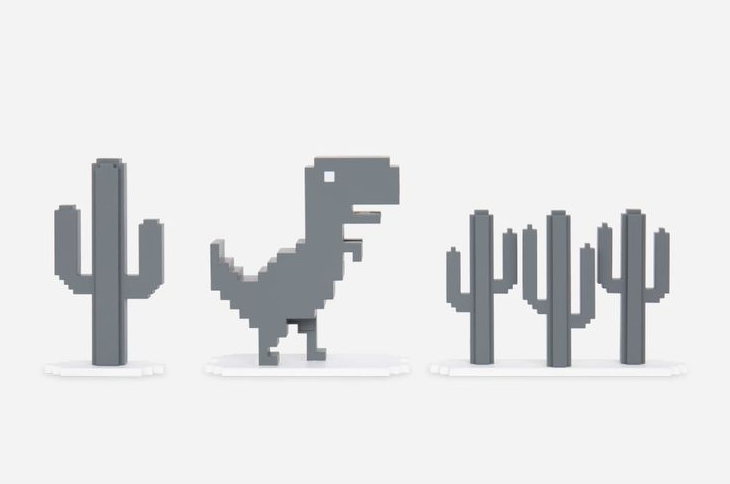
The Origin of the Dinosaur Game
The Dinosaur Game was first introduced by Google in 2014 as part of an update to its Chrome browser. Its creators—Sebastian Gabriel, Alan Bettes, and Edward Jung from the Chrome UX team—designed it as a fun distraction for users who had lost their internet connection. Instead of staring at an error message saying, “No Internet,” players would be greeted by a pixelated T-Rex standing in a desert. By pressing the space bar, the dinosaur would begin to run, transforming a moment of irritation into one of entertainment.
Interestingly, the developers referred to it internally as “Project Bolan,” a nod to Marc Bolan, the lead singer of the 1970s rock band T. Rex. Their idea was to create something “prehistoric” that reflected the state of being offline—like the internet had gone extinct for a while.
Gameplay Mechanics – Simple Yet Addictive
The controls couldn’t be easier: press the space bar or tap on your screen (on mobile) to make the dinosaur jump, and use the down arrow key to duck under flying obstacles. The goal? Run as far as you can without crashing into cacti or flying pterodactyls. There are no checkpoints, no power-ups, and no second chances—the game ends as soon as you hit an obstacle.
However, this simplicity is what makes the Dinosaur Game so compelling. It follows the purest form of the “endless runner” genre, where reflexes and timing are key. The speed gradually increases as you progress, and obstacles appear more frequently. The desert setting changes from day to night, adding a visual rhythm that keeps things interesting.
There is no grand storyline or complex graphics—just you, your T-Rex, and the challenge of beating your own high score.
A Symbol of Offline Entertainment
Part of the game’s charm lies in its context. Unlike most games, which are downloaded or launched intentionally, Dinosaur Game appears unexpectedly—only when you lose your internet connection. This moment of “forced disconnection” makes the game feel like a hidden gem, a small gift from Google to make an otherwise frustrating situation more tolerable.
Millions of users have discovered it by accident, often during times when they were trying to open a website, only to see the “No Internet” page pop up. But once they hit the space bar out of curiosity, the little dinosaur came to life—and a legend was born.
Design Philosophy – Minimalism at Its Best
From a design perspective, Dinosaur Game is a masterclass in minimalism. The black-and-white pixel art pays homage to early video games, evoking a sense of nostalgia while maintaining a modern polish. The T-Rex is drawn with just enough detail to make it expressive, even though it’s made up of simple square pixels.
The sound design is almost nonexistent—by default, the game runs silently, except for a small “boop” when you jump and a “crash” sound when you lose. This quietness contributes to its charm, allowing players to focus entirely on timing and rhythm.
Even the mechanics themselves are perfectly balanced. The first few seconds are slow and easy, giving players time to adjust, but as the speed ramps up, every jump becomes a split-second decision. It’s this escalating tension that hooks players for “just one more try.”
Cultural Impact and Legacy
What started as a small browser Easter egg has grown into a cultural phenomenon. Dinosaur Game has inspired countless memes, fan art, and remakes across different platforms. Developers and hobbyists have recreated it in various programming languages—Python, JavaScript, Unity, and even Scratch—making it one of the most copied and remixed mini-games in history.
There are also modded versions that give the game new life: some feature colored graphics, different environments (like outer space or underwater), or new characters replacing the T-Rex—everything from Mario to Sonic to cats. Schools have even used the game as a learning tool for beginner coders, encouraging them to study its simple mechanics.
In 2018, Google reported that over 270 million games of Chrome Dino were played each month—proof of its incredible popularity. That’s a staggering number for a game you can’t even find in the Play Store or App Store directly.
Hidden Features and Fun Facts
Despite its simplicity, the Dinosaur Game hides a few surprises:
-
Night Mode: After a certain score (usually around 700 points), the game switches from a bright desert to a dark night scene, with stars twinkling in the background. It then alternates between day and night as you keep running.
-
High Score Display: Your best score is saved in your browser’s local storage, so every time you play, you’re competing against yourself.
-
Cheat Mode: You can open the browser console (by pressing F12) and enter commands like
Runner.instance_.setSpeed(100)to make the dinosaur run insanely fast—or even make it invincible! -
Offline or Online: While it was originally meant for offline play, Google later allowed users to access it online by visiting chrome://dino or typing “Dinosaur Game” directly into Google Search.
Why It Endures
The reason Dinosaur Game continues to be loved after more than a decade lies in its universality. It transcends age, language, and culture. Anyone—from a child learning to use a computer to an adult stuck in an airport with poor Wi-Fi—can understand how to play it instantly.
It also symbolizes a timeless truth about games: you don’t need complex graphics or storylines to create something enjoyable. The sense of progress, the desire to beat your previous high score, and the quick restart after failure—all these elements make it endlessly replayable.
Moreover, it’s accessible everywhere. Whether you’re on a laptop, a phone, or even a smart fridge (yes, people have made it work there), Dinosaur Game is only one tap away. It’s a constant reminder that fun doesn’t have to be complicated—it can live in the simplest pixels.
Conclusion
Dinosaur Game is more than just a small browser Easter egg—it’s a minimalist masterpiece that represents the playful side of technology. In an era where internet downtime often feels like the end of the world, this tiny T-Rex reminds us to slow down, laugh, and embrace simplicity.
It’s a perfect balance between nostalgia and modern design, between frustration and joy. Whether you play it to kill time during an internet outage or just for fun, one thing is certain: once you start running, it’s hard to stop.
The T-Rex may live in a prehistoric desert, but its legacy in the digital world is anything but extinct.
Would you like me to make this article sound more journalistic (like a magazine feature) or SEO-optimized for a game website? I can adapt the tone and format accordingly.
Bạn đã nói:
ChatGPT đã nói:
Geometry Dash – The Rhythm of Challenge and Creativity
In a gaming world dominated by cinematic graphics and open-world adventures, Geometry Dash stands out as a phenomenon that blends rhythm, reflex, and pure precision. Created by Robert Topala under the developer name RobTop Games, this deceptively simple platformer has become a global sensation—addictive, frustrating, yet incredibly rewarding. Since its release in 2013, Geometry Dash has built one of the most passionate fan communities in gaming history, all centered around jumping to the beat and surviving impossible levels.
The Origins of Geometry Dash
Geometry Dash began as a solo project by Swedish developer Robert Topala, who wanted to create a rhythm-based game that was both challenging and satisfying. Using simple geometric shapes and electronic music, Topala managed to design something that felt intuitive yet punishingly difficult. The game was released on iOS and Android in 2013, later expanding to Windows and macOS platforms.
What’s remarkable is that Geometry Dash was made by just one person. With no giant studio or marketing team behind it, the game spread organically—through YouTube videos, mobile app recommendations, and word of mouth. Its catchy soundtrack and high difficulty instantly caught the attention of players seeking a new test of skill.
Gameplay – Precision Meets Rhythm
At its core, Geometry Dash is a rhythm-based platformer. Players control a cube (or other unlockable icons) that automatically moves forward. The only control you have is tapping the screen (or pressing space/left-click) to make the cube jump. The challenge lies in timing your jumps perfectly to the beat of the music, avoiding spikes, saws, and other deadly obstacles.
Every jump, flip, and gravity change is synced with the background music. The songs aren’t just for ambiance—they are your guide. The game rewards players who can listen and react rhythmically, making it as much a music game as a platformer.
As the levels progress, new mechanics appear: portals that change gravity, rockets that let you fly, teleport pads, and even ships that invert controls. Despite the chaos, everything feels perfectly tuned to the rhythm, which is part of what makes Geometry Dash so addicting.
Difficulty That Defines the Genre
One of the reasons Geometry Dash became legendary is its difficulty. Even the earliest levels demand focus and memorization, while the later ones—like “Clubstep,” “Electroman Adventures,” and “Deadlocked”—push players to the edge of their reflexes.
Failure is constant, but quick restarts make it easy to try again immediately. The loop of dying, retrying, and improving is what fuels the addiction. Each attempt feels like progress, no matter how small. Beating a hard level delivers an unmatched sense of accomplishment—especially after hundreds (or thousands) of failed attempts.
Unlike most mobile games that reward luck or in-app purchases, Geometry Dash rewards skill. Every jump you master and every obstacle you overcome is earned through persistence and timing. That’s why players proudly record and share their victories online—it’s not just gameplay; it’s a badge of honor.
The Soundtrack – Heartbeat of the Game
The music of Geometry Dash is more than just background—it’s the soul of the experience. Each level features a unique electronic track, often composed by artists from Newgrounds, an online creative community. Songs like “Stereo Madness,” “Back on Track,” “Cycles,” and “Theory of Everything” have become iconic within gaming culture.
The synchronization between sound and motion makes the game feel almost like a dance. Players aren’t just jumping—they’re performing choreography in perfect sync with music. This design choice creates a flow state where every beat matters, and every mistake feels like missing a step in a song.
The popularity of these songs also turned Geometry Dash into a bridge between gaming and music. Many fans discovered new electronic artists through the game, boosting the careers of several independent composers.
Level Editor – Where Players Become Creators
Perhaps the most groundbreaking feature of Geometry Dash is its level editor. Added shortly after the game’s initial release, it allows players to design their own levels using the same tools RobTop used himself. With thousands of elements, triggers, and customization options, the editor has transformed Geometry Dash from a single-player challenge into a community-driven creative platform.
Players can build anything—from simple obstacle courses to full cinematic experiences with moving backgrounds and storylines. Levels are shared online, where others can play, rate, and comment. Some fan-made levels are so complex and beautiful that they rival (or surpass) the official ones.
This endless supply of new content keeps the game alive. To date, millions of user-created levels exist, ranging from fun and easy to impossibly hard “Extreme Demons” that only a few elite players can complete.
The Community – Passion, Talent, and Dedication
Few games have a community as dedicated as Geometry Dash. On YouTube, Twitch, Discord, and Reddit, fans share their creations, stream level attempts, and even organize competitions. Famous creators like Viprin, GD Colon, and Zobros have become legends within the fandom, inspiring others to push the boundaries of what the game can do.
The game’s fanbase is also incredibly diverse—made up of both players and creators, musicians and coders, artists and animators. It’s not just a game community; it’s a creative ecosystem. Many young players learn the basics of design, programming logic, and rhythm through building levels.
Geometry Dash Updates and Spin-offs
Since its original release, Geometry Dash has seen several updates and spin-offs:
-
Geometry Dash Meltdown (2015)
-
Geometry Dash World (2016)
-
Geometry Dash SubZero (2017)
Each mini-version introduced new music and mechanics while serving as a teaser for future updates. However, fans waited years for version 2.2, which became one of the most anticipated updates in gaming history due to its promised new features like camera controls, new icons, and a multiplayer mode.
Despite the long wait, RobTop’s commitment to quality and the community’s patience have kept the hype alive. The developer’s transparency and humor have made him a beloved figure among fans.
A Symbol of Perseverance
What makes Geometry Dash special isn’t just its gameplay—it’s what it represents. The game teaches persistence, rhythm, and patience. It’s a digital metaphor for life’s challenges: you fail, you learn, and you try again. Every beat missed is a lesson, every attempt brings you closer to mastery.
This emotional connection explains why players keep coming back even after years. Completing a difficult level feels deeply personal—a triumph of focus and determination.
The Legacy of Geometry Dash
Today, Geometry Dash stands as one of the most influential rhythm games ever made. It’s taught millions of players to respect timing, rhythm, and precision. It’s also proven that a single developer, armed with creativity and passion, can create a masterpiece that inspires an entire generation.
The game’s blend of music, motion, and difficulty has influenced countless rhythm and platformer games that followed. Its community-driven design, with endless custom levels, has ensured it will never truly fade away.
Conclusion
Geometry Dash is far more than a mobile rhythm game—it’s a phenomenon built on passion, creativity, and challenge. It’s a place where frustration meets joy, where art meets code, and where every beat tests your determination. Whether you’re a new player struggling through “Stereo Madness” or a veteran conquering “Bloodbath,” Geometry Dash unites everyone through rhythm and persistence.
It reminds us that beauty doesn’t always come from complexity—it can emerge from perfect timing, simple shapes, and the power of music. As long as there’s a beat to follow and a jump to time, Geometry Dash will continue to pulse through the hearts of gamers worldwide.

 Arabic
 French
 Spanish
 Portuguese
 Deutsch
 Turkish
 Dutch
Dutch
 Italiano
 Russian
 Romaian
 Portuguese (Brazil)
 Greek
Greek