


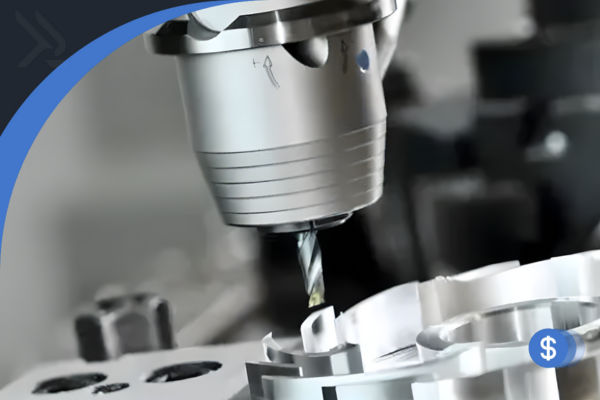
When undertaking a parts project—or evaluating a supplier quote—one of the trickiest challenges is predicting how much CNC machining will cost. Too low, and you risk underquoting, slim margins, or surprises. Too high, and you price yourself out of competition. At Precision Estimator, we built our CNC Machining Cost Estimator tool to demystify pricing and help engineers, procurement managers, and designers get realistic, defensible cost projections in the U.S. In this post, we’ll walk through how a good estimator works, what drives cost variation, and how to use estimates to your advantage when planning or negotiating.
How CNC Machining Cost Estimation Works (The Big Picture)
At its core, a CNC machining cost estimator breaks down costs into modular components and recombines them to yield a per‑part quote (or range). A typical structure looks like this:
Estimated Cost = Material + Setup & Tooling + Machining Time Costs + Finishing / Secondary Operations + Overhead / Margin
Each block has subfactors. As you tweak design, volume, or materials, the estimator recomputes. Let’s explore each component.
1. Material Cost
This is the cost of the raw stock needed for your part (block, bar, plate, rod, or billet). It depends on:
· Material type (aluminum, stainless steel, titanium, engineering plastics, etc.)
· Machinability (how easily the material can be cut)
· Scrap allowance or utilization (you may need extra to allow for unusable material)
· Price fluctuations (steel, aluminum, and specialty alloys often see volatile commodity pricing)
In many estimators, material accounts for 20–40% of total cost.
For instance, if your part requires 0.5 lb of 6061 aluminum at $3.50/lb, and your utilization is 80%, the raw material cost might be:
0.5 / 0.80 × $3.50 = $2.192. Setup, Tooling & Fixture Costs
Before machining begins, there’s preparatory work:
· CAM programming (creating toolpaths, verifying simulation)
· Fixture or clamping design/setup
· Selecting or purchasing cutting tools and inserts
· Trial cuts or first-article checks
These costs are often fixed per job (i.e. independent of quantity), and in low-volume or prototype runs, they dramatically impact per-part costs.
For example, a programming and fixture setup might cost $150 for a new design; in a one-off, that $150 is borne by a single piece, but spread over 100 pieces, it's only $1.50 per part.
3. Machining Time × Machine Hourly Rate
This is often the biggest cost driver.
· The machine hourly rate reflects labor, depreciation, energy, maintenance, overhead, etc. In the U.S., typical rates range from $40 to $200+ per hour depending on machine class and precision.
· The cycle time per part is influenced by material hardness, part geometry complexity, number of tool changes, number of setups, and whether multi-axis (e.g. 5-axis) operations are needed.
For example:
If the shop’s rate is $80/hour and your part requires 0.5 hours of machining (including tool changes), that component is $40.
4. Finishing, Inspection & Secondary Operations
After rough machining, most parts require additional processing:
· Surface finishes: anodizing, painting, plating, polishing, bead blasting, passivation, etc.
· Heat treatment or stress relief
· Deburring, cleaning, chamfering
· Inspection / quality assurance (CMM inspection, gauging, documenting)
· Assembly or post-machining operations (threading, tapping, inserts)
These operations typically add anywhere from a few dollars to tens of dollars per part. For example, anodizing an aluminum part might cost $0.50 to $2 per piece depending on size and finish.
5. Overhead, Profit Margin & Contingency
To remain sustainable, a shop adds margin and accounts for:
· Facility rent, utilities, insurance
· Software licenses, quality system compliance
· Administrative and support labor
· Risk or scrap contingency
Some estimators embed overhead in the machine hourly rate; others treat margin as a separate markup (e.g. 10–25%).
Example Estimate: A Small Aluminum Bracket
Let’s walk through a simple example to show how an estimator might operate:
Part: Aluminum bracket, ~1" × 2" × 0.25", moderate geometry
Volume: 50 pieces
Material: 6061 aluminum, $3.50/lb
Machine Rate: $90/hour (mid‑tier shop)
Setup & Tooling: $120
Post Operations: Deburring + anodize
1. Material Cost
Volume & utilization → ~0.1 lb each → cost ≈ (0.1 / 0.8) × $3.50 = $0.44 per part
2. Setup & Tooling (fixed)
$120 over 50 parts = $2.40 per part
3. Machining Time
Suppose each bracket takes 0.2 hour (12 min) → cost = 0.20 × $90 = $18.00
4. Finishing & Inspection
Deburring + anodizing = ~$1.50
5. Overhead & Margin
Assume 15% markup → On sum of the above
Sum of raw components = $0.44 + $2.40 + $18.00 + $1.50 = $22.34
Add 15% margin → ≈ $25.70 per piece
In practice, shops might round or include minimum order charges, but this gives you a ballpark you can rationalize.
Key Cost Drivers & Tips to Optimize
Understanding what pushes a machining cost higher gives you leverage to reduce it. Here are some levers:
Geometry & Complexity
· Avoid excessive internal cavities, deep pockets, or tight internal corners
· Minimize the number of setups and transitions between axes
· Simplify features (e.g. standard hole sizes, avoid micro-slots where possible).
Tolerances & Surface Requirements
· Use tighter tolerances only where function demands it
· Prefer standard surface finishes over exotic ones
· Specify GD&T only on critical features.
Batch Volume
· Small runs (1–10 pieces) almost always carry a higher per-unit cost
· As volume increases, setup and fixture costs spread out
· Even modest increases (e.g. from 5 → 20) may halve per-piece cost in some cases.
Material Choice
· Use machinable materials (6061 aluminum, mild steels, POM)
· Avoid exotic alloys (titanium, Inconel, hardened steels) unless necessary
· Reuse leftover stock where possible
Toolpath Optimization & CAM Efficiency
· Adaptive toolpaths, high-efficiency strategies, and minimizing air cutting help reduce cycle time
· Use proven tooling and minimize tool change penalty
Why U.S. Shops Are More Expensive—and When It’s Worth It
U.S.-based CNC shops tend to charge more than offshore alternatives. Typical hourly machining rates in the U.S. range between $60 and $120 (or higher for specialized work). Some quotes exceed $200/hr for high-end parts.
That said, U.S. shops offer advantages that often justify the premium:
· Proximity and reduced lead times
· Intellectual property protection
· Easier communication and oversight
· Higher consistency, quality systems, and regulatory compliance
· Lower shipping and import risk
As Davantech notes, while manufacturing costs may be 50–80% lower in China, local U.S. support and precision often tilt decision-making toward domestic providers. For critical aerospace, defense, medical, or high-reliability projects, many buyers accept the cost in exchange for peace of mind.
Integrating a CNC Machining Cost Estimator Into Your Workflow
Here’s how to leverage an estimator (or your own rough calculations) in your decision-making:
1. Preliminary Design Phase
o Use a cost estimator early to catch cost escalators
o Adjust geometry, material, or tolerances before finalizing the design
2. Supplier Negotiation
o When you receive vendor bids, compare against your estimate
o Ask suppliers to break out cost components (machining, tooling, finishing)
3. Trade‑offs & What‑If Scenarios
o Use the estimator to test what happens if you increase batch size, relax tolerances, choose alternate finishes, etc.
o You may find small changes yield large cost reductions
4. Feasibility Check for Outsourcing
o Compare U.S. shop estimates versus offshore alternatives
o Factor in logistics, import duty, quality risk, and lead time, not just raw price
At Precision Estimator, our CNC Machining Cost Estimator helps you perform all these steps automatically—giving credible, auditable cost ranges in seconds.
Conclusion:
Estimating CNC machining costs isn’t magic—it’s the careful aggregation of material, setup, machining, finishing, and overhead expenses. The more clearly you model each factor, the more reliable your estimate becomes. For U.S.-based manufacturing, while hourly rates may be higher, the benefits of locality, quality, and responsiveness often make domestic sourcing the smart choice.
If you’re an engineer, buyer, or product manager tasked with quotation or supplier selection, consider putting a CNC Machining Cost Estimator to work as an essential tool. At Precision Estimator, we offer you that capability, tailored for U.S. manufacturing standards.

 Arabic
 French
 Spanish
 Portuguese
 Deutsch
 Turkish
 Dutch
Dutch
 Italiano
 Russian
 Romaian
 Portuguese (Brazil)
 Greek
Greek