


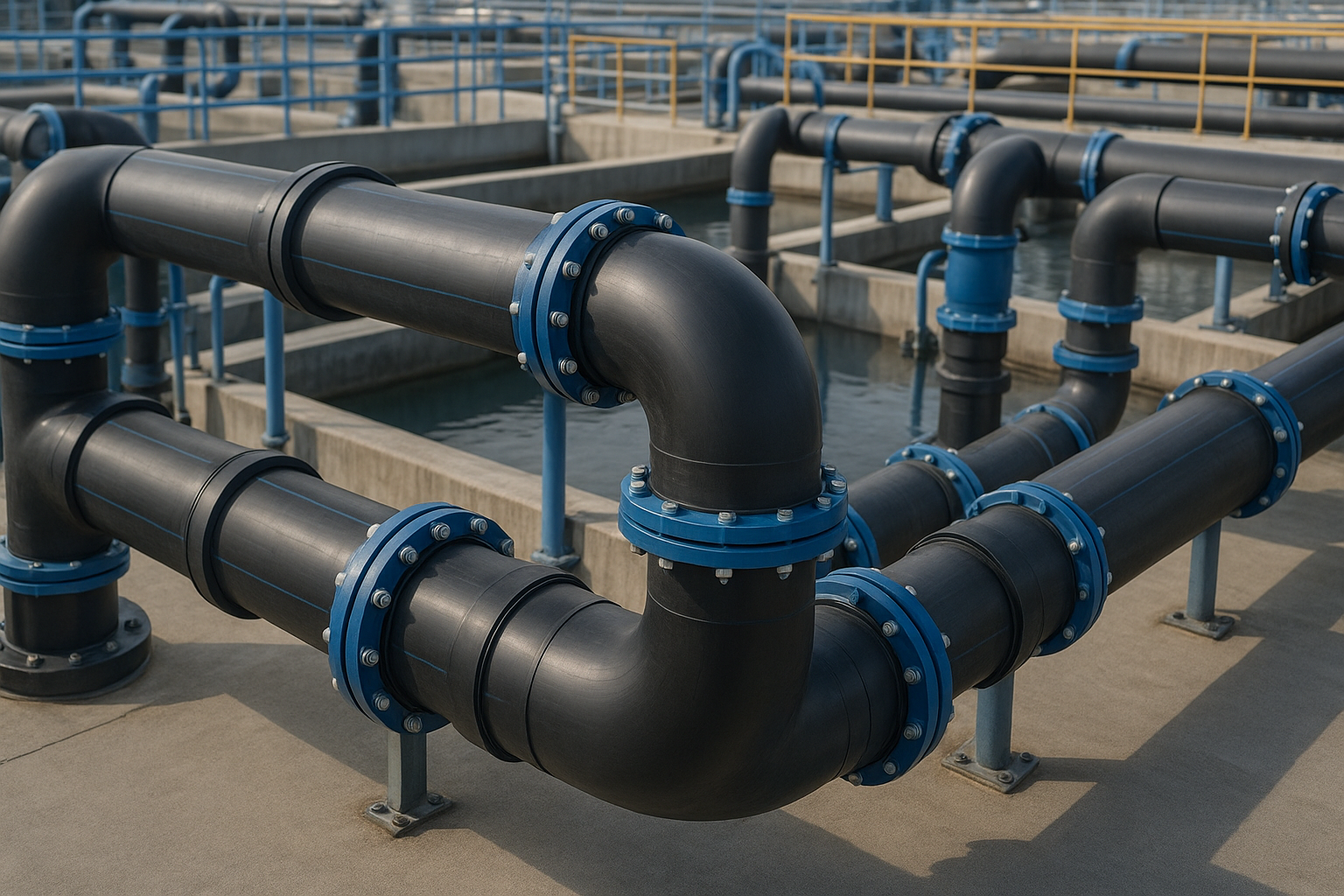
In modern water treatment systems, the choice of piping material plays a critical role in determining system efficiency, longevity, and water quality. Both MDPE and HDPE materials are widely recognized for their durability and corrosion resistance, making them the backbone of reliable water networks.
The shift toward HDPE Pipes & Fittings has significantly improved the performance of large-scale water treatment projects. Their superior strength, flexibility, and leak-proof jointing technology make them the ideal choice for long-term, maintenance-free water management systems. Whether used for potable water, wastewater, or industrial applications, HDPE ensures consistency, safety, and cost efficiency across operations.
Understanding MDPE and HDPE Pipes
MDPE (Medium Density Polyethylene) Pipes
-
Designed for low to medium pressure applications.
-
Known for lightweight construction, easy handling, and corrosion resistance.
-
Commonly used for domestic, municipal, and small-scale distribution networks.
-
Offers moderate flexibility suitable for underground installation.
HDPE (High Density Polyethylene) Pipes
-
Made for high-pressure and heavy-duty applications.
-
Exhibit greater tensile strength, impact resistance, and chemical durability.
-
Perfect for industrial and municipal water networks that demand long service life.
-
Compatible with advanced fusion welding techniques for seamless connections.
While both MDPE and HDPE ensure safe water transportation, HDPE Pipes & Fittings are more resilient and reliable under demanding operational conditions. Their high density and molecular structure provide exceptional resistance to stress and external load, ensuring long-term stability and leak-free performance.
Why HDPE Pipes Are the Preferred Choice for Water Treatment Systems
Transitioning from MDPE to HDPE offers multiple performance and economic advantages. HDPE’s mechanical strength and chemical resistance make it a preferred option for complex treatment processes.
Key Advantages Include:
-
Chemical Compatibility: HDPE resists a wide range of treatment chemicals such as chlorine and coagulants.
-
High Durability: Maintains structural integrity even under fluctuating temperatures and pressures.
-
Leak-Proof Fusion Welding: Heat-fused joints eliminate the risk of weak points or leak zones.
-
Low Maintenance: Long service intervals and minimal repairs lower total life-cycle costs.
-
Operational Safety: Smooth interior walls prevent scaling, biofilm buildup, and contamination.
In comparison, metal pipes are prone to rust, while PVC pipes may crack under pressure. HDPE Pipes & Fittings combine strength with flexibility, making them ideal for both underground and above-ground water treatment systems.
Benefits of Using HDPE Pipes & Fittings in Water Treatment
Implementing HDPE in water treatment systems delivers measurable technical and operational benefits:
-
Corrosion and Abrasion Resistance: Perfect for handling chemically treated and abrasive fluids.
-
Extended Service Life: Capable of lasting over 50 years with minimal degradation.
-
Installation Flexibility: Can be installed using trenchless techniques or above-ground supports.
-
Reduced Energy Loss: Smooth internal surface reduces friction, improving flow efficiency.
-
Environmental Safety: Non-toxic material ensures safe potable water transport.
-
Cost Efficiency: Reduced leakage and maintenance result in long-term financial savings.
By integrating HDPE Pipes & Fittings, water treatment facilities achieve uninterrupted operations, reduced repair needs, and improved water quality throughout the system.
Integration with Water Treatment Infrastructure
HDPE’s versatility allows seamless integration into every stage of water treatment, from raw water intake to treated water distribution.
Applications Include:
-
Raw Water Supply Lines: Transporting untreated water from reservoirs or borewells.
-
Filtration Systems: Withstanding pressure variations in multi-stage treatment units.
-
Treated Water Distribution: Ensuring clean, contamination-free delivery to storage or end users.
-
Effluent Disposal Networks: Safely transporting treated wastewater for reuse or disposal.
HDPE Pipes & Fittings are also compatible with key system components like pumps, valves, and tanks. When combined with MDPE networks, they form a hybrid system that balances cost-effectiveness with superior performance — a preferred solution for municipal and industrial projects alike.
Frequently Asked Questions (FAQ)
Q1: What makes HDPE Pipes & Fittings suitable for water treatment systems?
Their combination of durability, flexibility, and chemical resistance makes them ideal for handling both clean and treated water. Fusion-welded joints provide complete leak protection, ensuring uninterrupted operation.
Q2: Are HDPE pipes better than MDPE for all applications?
Not in every case. HDPE is preferred for high-pressure and industrial systems, while MDPE remains suitable for smaller-scale or low-pressure applications such as residential supply lines.
Q3: How long do HDPE pipes last in water treatment plants?
With proper installation, HDPE Pipes & Fittings can last 50–100 years, depending on operating conditions and maintenance routines.
Q4: Can HDPE pipes be used for both clean and wastewater?
Yes. HDPE is non-toxic, resistant to microbial growth, and durable, making it suitable for both potable and non-potable water transport.
Q5: How do HDPE fittings prevent leaks?
Fusion welding creates monolithic joints — meaning pipes and fittings fuse into one continuous piece without seams or gaskets, eliminating any leakage risk.
Conclusion
Selecting the right piping material is fundamental to creating a durable, leak-proof, and efficient water treatment system. While MDPE pipes remain effective for lighter applications, HDPE Pipes & Fittings offer unmatched performance under demanding operational and environmental conditions.
Their exceptional strength, flexibility, and corrosion resistance make them the backbone of modern water and wastewater infrastructure. When integrated with existing MDPE systems, HDPE enables a hybrid approach that combines cost efficiency with reliability.
Investing in HDPE today means investing in cleaner water, lower maintenance, and sustainable infrastructure for decades to come.

 Arabic
 French
 Spanish
 Portuguese
 Deutsch
 Turkish
 Dutch
Dutch
 Italiano
 Russian
 Romaian
 Portuguese (Brazil)
 Greek
Greek